Ballybunion
Where towering dunes and howling Atlantic winds turn a links pilgrimage into a test of survival.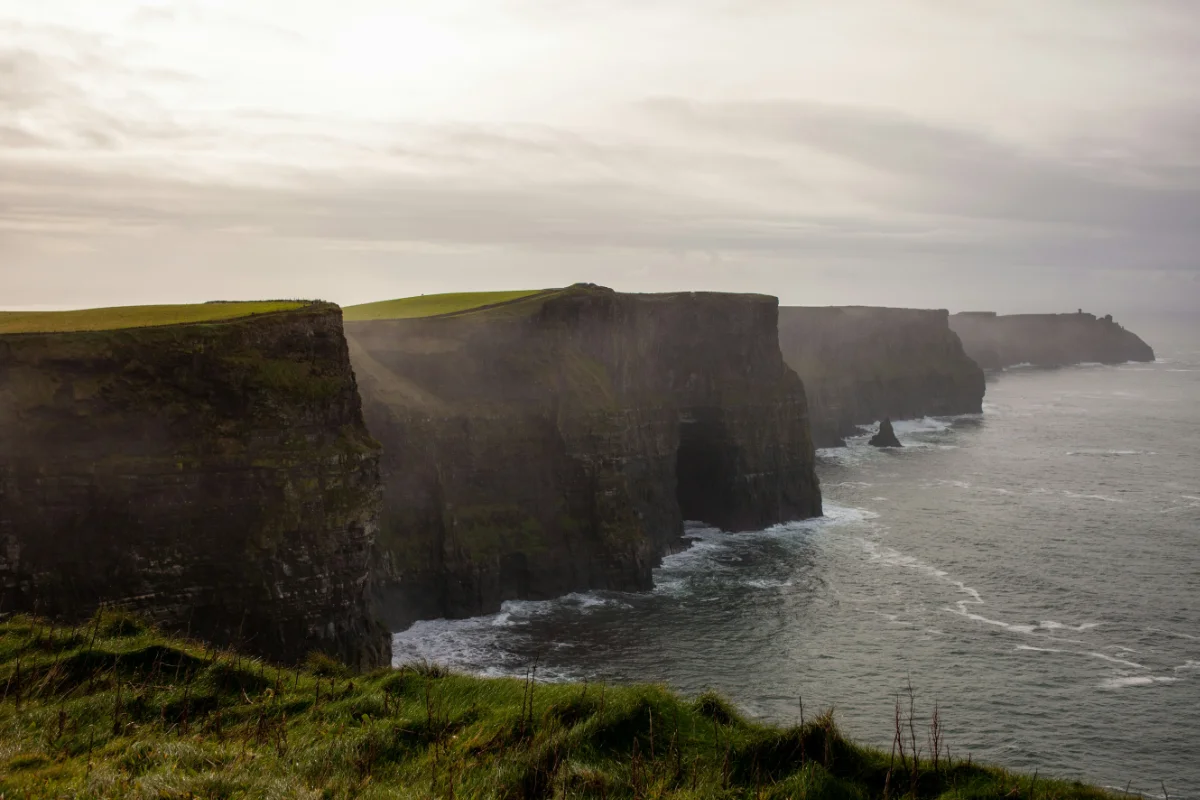
I’m usually a bit on edge in airports, especially at passport control. Paranoia? Possibly. But it doesn’t help when you’re the somewhat resentful owner of a South African passport.
Of all the member states of the European Union, only one still has a shred of respect for the thing: Ireland. Yes, the Emerald Isle is the only EU country that South Africans can visit without having to go through the rigmarole of applying for a Schengen visa. Thanks to this leniency, I didn’t feel like a complete pariah when, early one morning in August, I stood red-eyed in Shannon Airport, awaiting judgment.
What cool I had was lost the moment I laid eyes on the man with the stamp: a gray-haired geezer wearing an expression that suggested he was sucking on a slice of lemon. His interrogation bore out his demeanor: tough, laconic—until I mentioned I was playing Ballybunion the next day.
His eyes lit up and he began giving me tips. He spoke at such length that the queue behind me grew restless, and I tried to communicate to them, by means of a quick glance, that the delay wasn’t my doing.
“Can you play a stinger?” he asked, as I turned back to him.
“Can I what?”
“Can you play a stinger?”
“Oh, uh, yes,” I said, recalling a few successes. “Cape Town is quite windy.”
“Three feet off the ground?”
“What?”
As I awaited my clubs at the baggage collection point, I tried to visualize myself hitting this shot, this femur-threatening bullet, but it was impossible, akin to imagining a fourth dimension.
I wasn’t worried, though. I had quickly come to the conclusion that the man had, in jest, exaggerated the whole three-foot business. In a country as steeped in mythology as Ireland, such exaggerations are to be expected. And if that morning’s weather was anything to go by, I wouldn’t even need a stinger. The sky was blue and, most importantly, the breeze gentle. No, I thought, I’d be alright.
That evening a storm rolled in, knocking the electricity out of my room. I thought I might not even be able to play. So, while the friendly ladies of Ballybunion Golf Hotel scuttled to fix up a new room for me, I sprinted through the rain to McMunn’s for a pint. I asked the bartender if he thought my round would be canceled.
He frowned.
* * *
Moments after winning the 1982 US Open at Pebble Beach, Tom Watson was asked to name his favorite golf course. “Ballybunion,” he said. Why? It had it all.
The American had only one complaint about his trip to southwest Ireland the year before: there had been no wind—and Watson liked a bit of wind when he teed it up.
He must have been seeking a challenge, because the best he could do around the par 71 in calm conditions was scores of 72 and 71. That tells you something about the difficulty of the course, which measures a mere 6,220 meters from the tips. “Wind is merely a witch’s bonus,” golf writer Marino Parascenzo said of it. “It needs no outside help.”
I was blissfully unaware of its associations with the occult as I joked around with my playing partners on the 1st tee box. I’d assumed the wind (wailing) was integral to the course—a necessary defense—as it is at most links layouts. I didn’t dread my round. If anything, I felt rather fortunate: the rain had stopped.
In retrospect, I should’ve seen what was coming. As I took in the lay of the land, I noticed a crowd of Celtic crosses glaring at me from behind a ragged stone wall to the right of the fairway.
“Is … is that a graveyard?” I asked the starter.
He chuckled.
“Yes.” And in case I was some sort of play-it-as-you-lie freak, he added, “It’s out of bounds.”
* * *
The opening stretch of holes at Ballybunion is nothing to write home about. Yes, the par-four 2nd, with its blind approach shot and raised green, will stay with me, but only once we reached the seaside 7th did I begin to grasp what the fuss was about.
The holes from here onward, I suspect, sparked the enthusiasm in the old man at passport control, and prompted Seve Ballesteros to refer to Ballybunion as “a piece of art, a unique stretch of land”. It is here that you become acquainted with Ballybunion’s greatest defense and allure: its dunes.
Parascenzo captured them best: “They look like great, humped, shaggy beasts of science fiction. You are overwhelmed as the dunes tower above you, treeless, stealing any sense of perspective. There is an emptiness, a sense of loss, an eerie silence. You are adrift on dry land.”
No hole serves as a better example of Ballybunion’s brutality than the par-four 11th. The tee shot must carry thick rough and avoid the Atlantic on the right. But don’t get too excited if you manage to avoid disaster. The hardest shot is yet to come.
At 432 meters off the back tee, this hole will dish up a lengthy approach shot regardless of the quality of your drive. And what an approach shot it is. The fairway soon dips sharply to a terrace, then dips to another, rushing from broad to narrow mercilessly, twisting like a great snake at the bottom before sneaking between two shaggy dunes and up to the narrow green.
“Everywhere else, there is that demon grass,” said Parascenzo. “A stray ball generally is a lost ball. No matter, because a found ball is probably unplayable. You need a machete, not a wedge.”
I soon went into survival mode. The round became a matter of finishing with some dignity. The swaying grass … it looked so inviting at times. To lie down between its strands and crawl up into the fetal position … close my eyes.
I have long suspected that golfers possess a streak of masochism. It’s the only explanation I have for why somebody would put up with this wicked pursuit for more than a few months. It’s certainly a prerequisite for enjoying Ballybunion in 60km/h winds—a case, if ever there was one, of a good walk spoiled.
Collapsing into a chair after my round, I felt like Lucky Jim when he woke up with a particularly nasty hangover: as if I had been on a cross-country run and then been expertly beaten up by the secret police. I felt bad. And because of it I (kind of) felt good.
A golfer can only take so much pain. That’s why I’m glad I ended my trip at the cushy Trump International Golf Links in Doonbeg.
I didn’t have time to be pampered at the resort spa, but the old-world hotel with its comfortable rooms, Irish fare, and caring staff (who I believe sensed my fragile state) all contributed to a serene, healing experience—a peacefulness which extended to my round the following morning.
It was one of those murky, windless days. And whereas Ballybunion was packed, the Greg Norman-designed links was nearly deserted. For most of the round, the closest thing I had for company was cattle grazing in the distance. There was also that jumpy springer spaniel that accompanied me down the last, just as the rain, which had been threatening the whole day, began to lash down.
As I was about to putt out, he picked up my ball and tossed it aside, as if to say: come on, let’s play some more. And boy, did I want to. But my three days were up. I’d have to come back another time.
Hopefully, the old man at passport control will still be there.
First published in the December 2015 issue of Compleat Golfer Magazine.
Photo by Ben Eubank.